
The Chorus, released in 2004, became an astonishing phenomenon, attracting millions of viewers and winning numerous awards.
More than twenty years ago, the film premiered in French cinemas, and the now-famous melodies by Bruno Coulais spread across the world. This musical comedy-drama won over both audiences and critics, becoming the most successful film of the year in France. Nominated eight times for the César Awards and twice for the Oscars, The Chorus won the French statuettes for Best Music and Best Sound.
The story follows Pierre Morhange (Jean-Baptiste Maunier), a somewhat lost boy rescued by music — or rather, by his mentor Clément Mathieu (Gérard Jugnot). Mathieu is not a successful musician, but an excellent singing teacher. In 1949, unemployed and desperate, he accepts a job as supervisor at a boarding school for boys whom society did not abandon but simply forgot. The institution’s name speaks for itself: ‘Bottom of the Pond.’ Shocked by the harshness and rough methods of the school’s director, Monsieur Rachin (François Berléand), Mathieu decides to use his love of music to help the children, transforming the group of boys into a choir and changing their daily lives — and their futures.
Read more: How ‘The Pianist’ Changed Adrien Brody
The screenplay was based on Jean Dréville’s 1945 film A Cage of Nightingales, which director Christophe Barratier had seen during his childhood. The story resonated with him because he, too, experienced a difficult upbringing. His parents separated, and at a young age he was sent to live with his grandmother in the provinces, where he felt similar to Pépinot, the orphan in the film, waiting at the school gates for a father who never came. His relationship with his mother was also painful.
Barratier decided to soften the tone of A Cage of Nightingales, shifting toward idealism while keeping the emotional weight. He aimed to tap into the universal experience of childhood and the psychological power of fairy-tale–like storytelling, believing his own childhood wounds were shared by many. Working with screenwriter Philippe Lopes-Curval, he removed nostalgic elements and focused on authenticity. He later explained that he deliberately avoided an overly ‘happy ending’ and gave clear personalities to four or five children, unlike the original film, where only two stood out from the collective group. He sought a balance — a tragicomedy, but still primarily a comedy.

To cast the seventy boys who would play the students, the director auditioned more than 300 children from youth homes and schools in disadvantaged neighborhoods, many of whom faced serious difficulties in real life.
Barratier felt the story needed classical music and a universal theme that could speak to any child, regardless of social class, race, or background. His goal was to leave audiences with a sense of inner strength to face life’s hardships — a feeling rarely found in reality. He hoped the film could offer viewers tools to imagine life as it could be, not only as it is.
The summer of 2003 was extremely hot — the first truly intense heatwave that France would remember for years. Filming took place in this sweltering environment, even though the movie included winter scenes. For these, the crew used materials resembling dry ice on the castle façade and removed all visible leaves from the trees. Getting the children to wear sweaters in such conditions required considerable effort. Assistant director Vincent Calouza later recalled the atmosphere as being like a real summer camp.
During one interview, Gérard Jugnot confirmed rumors that some scenes were filmed while he and François Berléand wore only swim trunks behind the camera frame due to the unbearable heat, as long as the camera stayed above the waist.
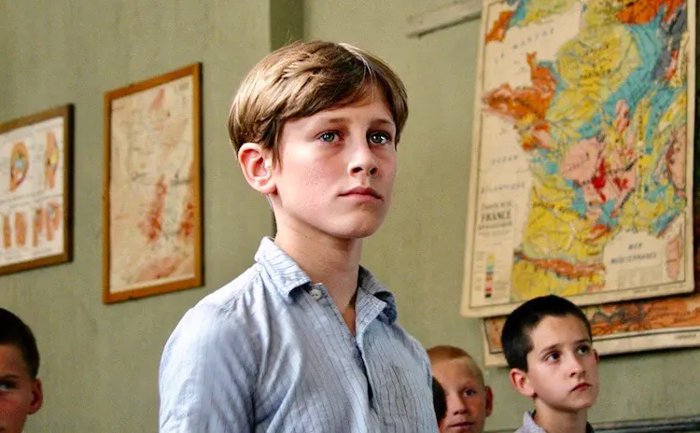
Jean-Baptiste Maunier as Pierre Morhange
Music is central to the story, and much of the film’s success is due to the popularity of its soundtrack — especially the song ‘Vois sur ton chemin’ (‘Look to Your Path’). Coulais worked closely with the director, fully immersing himself in the production. On set, choir director Nicolas Porte from the Saint-Marc Choir of Lyon was present to train the young actors and help Jugnot embody the role of the singing teacher. His choir also recorded the soundtrack. Among the children, only Jean-Baptiste Maunier, who played Pierre Morhange, sang with his real voice. Barratier discovered him after visiting twenty-five choirs across France.
The final days of filming were emotionally difficult for the boys, who were deeply moved by the story. They could not yet know that the film’s triumphant reception would forever secure their faces in cinematic history. Jugnot later noted that the film became a social phenomenon, especially abroad, and that it remained remarkably timeless — a work still remembered by everyone who saw it.
Read more: What Does the KGB Have to Do with ‘Amadeus’?