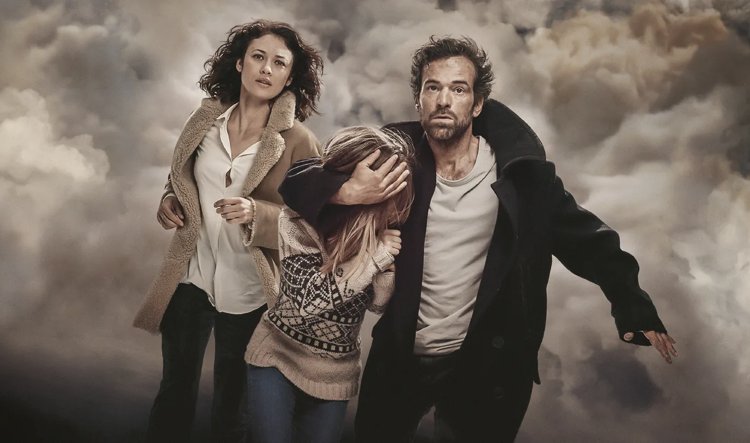
The French dystopian thriller ‘A Breath Away’ (Dans la brume, 2018), directed by Daniel Roby, presents viewers with a chilling scenario: within hours, romantic Paris is engulfed in a deadly toxic fog. The only way to survive is to flee upward — to the rooftops of skyscrapers and historic buildings.
At the center of the story is a married couple, played by Romain Duris and Olga Kurylenko, whose daughter is confined to a specialized medical chamber because of a rare illness. Cut off from food, water, and communication, they are forced to fight for their child’s survival in the heart of a blinded metropolis. The film’s atmosphere strongly echoes Stephen King’s cult novella The Mist, which was adapted into a feature film in 2007 and later inspired a Netflix series.
An Apocalypse on Set
Creating the film’s suffocating tension turned out to be just as challenging behind the scenes as it was on screen. Duris and Kurylenko later admitted that the production became one of the most physically and emotionally exhausting experiences of their careers, largely because of the omnipresent artificial fog.
According to Duris, it was technically impossible to fully clear the fog between takes, leaving the actors trapped for hours in a dense, disorienting environment where they often relied more on instinct than sight. Since nearly half of the movie takes place inside the fog, the cast had little relief from these conditions.
Read more: How Dwayne Johnson Prepared for His Most Human Role in ‘Skyscraper’
The constant use of oxygen masks added another layer of difficulty. The actors struggled to hear one another properly, as the masks distorted sound and made even simple dialogue scenes unusually demanding.
Director Daniel Roby reportedly pushed the cast and crew relentlessly in pursuit of realism and intensity. Scenes were filmed from numerous angles with an enormous number of takes, creating a frantic pace on set that left the actors genuinely drained. Kurylenko later suggested that this exhausting rhythm may have been intentional, as it helped produce the raw tension visible on screen.
The physical strain became so severe that the actress experienced intense dizziness during the first week of filming. Looking back on the production, Kurylenko admitted that the exhaustion audiences see in the film was entirely real — but, in her view, the final result justified the ordeal.
Read more: Behind the Scenes: How the Iconic Jump in ‘A View to a Kill’ Was Filmed