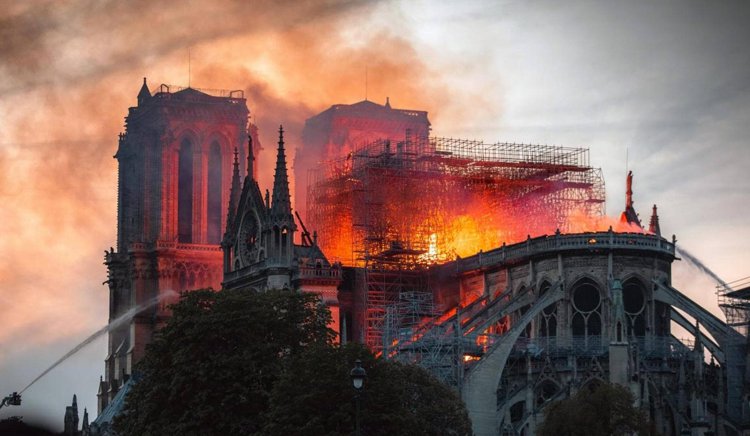
The fire at Notre-Dame Cathedral on April 15, 2019, became an event the entire world watched live, holding its breath. Several years later, renowned French director Jean-Jacques Annaud — known for his large-scale productions in China (‘Wolf Totem’), the Middle East (‘Black Gold’), and Cambodia (‘Two Brothers’) — found a dramatic story in the very heart of Paris. His film ‘Notre-Dame on Fire’ (2022) became a unique blend of genres, where documentary precision meets the techniques of a gripping thriller.
Annaud deliberately avoided rigid genre boundaries. Although the film is entirely based on the real events of that unforgettable night, the director constructed the narrative drawing on the classic lessons of Alfred Hitchcock. Elements of a disaster movie intertwine with archival footage, creating a powerful sense of immersion.
Read more: What Do ‘Harry Potter’ and the Moscow Metro Have in Common?
For the director, it was crucial not merely to record the chronology of events but to appeal to the audience’s emotions. He approached the material almost like an artistic mystification that, ironically, turned out to be absolute truth. Many details — for example, the presence of two women in the first fire brigade to arrive at the scene — may seem like a screenwriter’s invention to viewers, yet they are strictly documented facts, even though women make up only about one percent of all firefighters in Paris. And they very rarely respond to major fires.
Reality Surpassing Fiction
The preparation for filming resembled detective work. Annaud studied an enormous body of documents. His research into the fire revealed that many aspects of what happened appear unbelievable precisely because they are real. Among the testimonies used for the screenplay were accounts from eyewitnesses and participants in the events, whose stories often contradicted one another. In each case, the truth had to be carefully reconstructed.
For example, the story of the rescue of the Crown of Thorns of Christ was told to him by three different people. The director had to compare the facts to expose two of them as unreliable and reconstruct the true sequence of events.
Annaud ultimately concluded that the tragedy resulted from what he described as a “mind-boggling alignment of the planets” — a chain of absurd coincidences, technical failures, and human factors. Until the very last moment, no one could believe that the stone symbol of a nation could actually burn. One of the first people to call the firefighters was the mayor of Paris, yet she believed the smoke was coming from somewhere in that district. It couldn’t possibly be Notre-Dame that was on fire. The film pays special attention to the moment when the cathedral stood on the brink of total collapse, which could have caused a devastating blaze across the entire Île de la Cité.
Ordinary People Against ‘Superheroes’
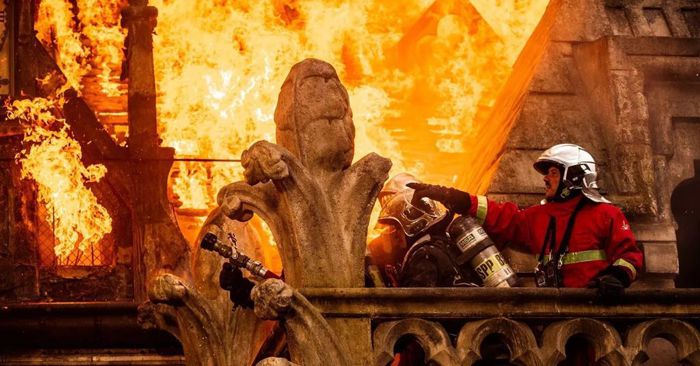
One of the film’s central themes is admiration for the professionalism of firefighters. Annaud — who was later named an honorary first-class firefighter after the production—contrasts real people risking their lives to save cultural heritage with the now-overfamiliar superheroes of Marvel. For him, it was important to portray the solidarity and humility of ordinary professionals in a world overwhelmed by chaos.
“I have always liked ordinary heroes. I hate Marvel movies; I’m tired of superheroes and I don’t believe in them. But I admire simple people who risk their lives to save stones,” he said.
The director follows the principle of his colleague, the screenwriter and actor François Truffaut: there is no good fiction film that is not also a good documentary. Viewers of Notre-Dame on Fire follow the firefighters through the cathedral’s galleries and corridors, not always understanding the technical details but fully trusting the professionalism of the characters and the director’s vision. “Hitchcock said that it’s not necessary for the audience to understand everything, but it’s important that they understand the characters on screen understand everything,” Annaud explained.
Visual Reconstruction
The technical side of the production required meticulous work. Since Notre-Dame itself was closed for restoration, Annaud used the cathedrals of Sens Cathedral and Bourges Cathedral, combining angles and studio sets to recreate the appearance of the Paris landmark before the catastrophe. “We used the paving stones of Sens, which Paris copied thirty years later for Notre-Dame Cathedral,” Annaud noted.
The entire visual design, editing structure, and musical accompaniment were carefully planned by the director six months before filming began. Such thorough preparation allowed the team to convey the full scale of the disaster — from the first spark to the collapse of the spire and the desperate struggle to save each relic.
A Philosophical Conclusion
While finishing the film, the 78-year-old Annaud did not aim to impose a specific conclusion on viewers. Following the philosophy of Umberto Eco, he gave the audience the freedom to interpret what they saw through the prism of their own experience. For him, Notre-Dame on Fire is a story about how, in conditions of total unpreparedness and chaos, humanity managed to perform a miracle: preserving a great monument without losing a single human life.
Read more: The Making of John Carpenter’s ‘Halloween’