In Soviet cinema, the horror genre remained almost exotic for a long time. Film was regarded as one of the most important instruments of ideology, and movies filled with anxiety and dark themes did not fit easily into that system. Only in the 1980s, when the policy of Glasnost (policy of openness and transparency) broadened the boundaries of what was permissible, did films begin to explore fear — not mystical fear, but existential dread.
One of the key works marking this shift was the film Dead Man’s Letters by director Konstantin Lopushansky. Lopushansky had dreamed of making this film since the early 1980s. He worked on the screenplay together with Alexei German, Vyacheslav Rybakov, and Boris Strugatsky.
Nuclear Winter as Metaphor and Warning
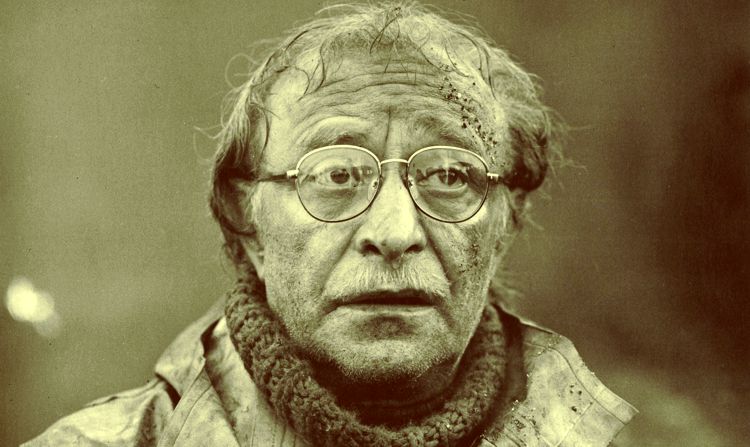
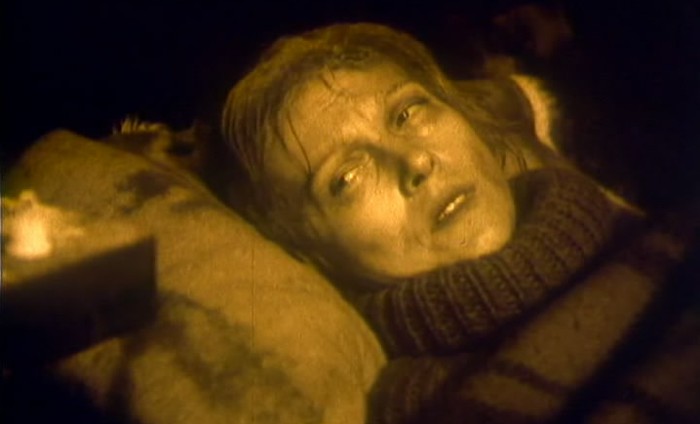
The film is set in an unnamed city after a nuclear catastrophe. To avoid problems with censorship, the location was never explicitly identified, yet the scale of the tragedy was clear to everyone. The protagonist is Professor Larsen, a scientist and Nobel laureate portrayed by Rolan Bykov. Having survived the explosion, he hides in the basement of a historical museum with a handful of other survivors, cares for his dying wife, and writes letters to his son, who has likely perished.
These letters become an attempt to preserve a human voice in a world where civilization has vanished. Together with the other survivors, Larsen struggles to comprehend the terrible truth: humanity has destroyed itself with its own hands.
The Legacy of Tarkovsky
Vera Mayorova-Zemskaya
Lopushansky was a student of Andrei Tarkovsky. His experience working as an assistant during the filming of Stalker helped shape his own visual style. The influence of the master is felt in Dead Man’s Letters almost at the level of tone: slow, hypnotic shots, a dense atmosphere, and a nearly monochromatic visual palette. If Tarkovsky portrayed the world outside the Zone as black-and-white and dim, Lopushansky immersed the viewer in the colors of an old photograph — a yellow-brown sepia filter that conveys a scorched, lifeless world where sunlight no longer penetrates the haze. This artistic choice intensifies the sense of the world’s end, bringing the film closer to a philosophical parable than to traditional horror.
Film scholars have often seen in the character of Larsen a reference to Andrei Sakharov — a scientist who came to understand the destructive power of the weapons he helped create. In this way, the hero’s personal drama becomes a moral question about the responsibility of science and humanity.
Behind the Scenes
The production process became a true test of endurance for the crew. The original plan to film at the forts of Kronstadt in the Gulf of Finland was abandoned when the team discovered an ideal location: a half-ruined building in Oranienbaum that had already been slated for demolition. There they built, almost from scratch, the set of a deserted city, filling the space with old car bodies and street lamps.
One of the most oppressive scenes — the flooded library — was filmed in charred gas holders near the Frunzensky Department Store, while the professor’s shelter was arranged in a church basement.
Read more: The Soviet ‘Lord of the Rings’: A Forgotten Adaptation of J. R. R. Tolkien
Initially, it had been planned that Professor Larsen would be dubbed by Zinovy Gerdt. For Rolan Bykov, who had lived through the role emotionally, this decision became a personal drama. In his memoirs, the actor admitted how painful it was for him to imagine “losing” his own voice on screen. Bykov believed that only his own intonation and delivery could complete the character. In the end, he defended this right, and his performance was fully recognized — he was awarded the USSR State Prize for the role.
Coincidence and the Effect of Prophecy
The film was released in 1986, five months after the catastrophe at the Chernobyl Nuclear Power Plant. This gave the picture a special intensity: audiences already shaken by the news saw on screen images disturbingly similar to a radiation disaster. The authenticity was no coincidence. Lopushansky invited academician Nikita Moiseyev — one of the creators of the mathematical model of Nuclear Winter — as a scientific consultant.
Thanks to this collaboration, the film convincingly portrayed the consequences of a global catastrophe: the collapse of ecosystems, a dramatic drop in temperature, and a gray veil swallowing the remnants of life.
A Timeless Warning
Many viewers perceived Dead Man’s Letters as a prophecy. Yet the director himself saw the film not as a prediction but as a warning. It was created against the backdrop of the Cold War, when the threat of a nuclear strike felt almost tangible, and it reflected the fear of civilization’s self-destruction.
Even today, the film continues to unsettle audiences precisely because of its restraint. There are no familiar genre special effects. The horror emerges from the atmosphere, from the slow realization of inevitability, and from the question the film poses to the viewer: what will remain of humanity if the world it created disappears?
Read more: American Director Alik Sakharov: “I Belong to My Soviet Roots”
Dead Man’s Letters remains a rare example of a Soviet horror film where fear is connected not with monsters but with reality itself. Perhaps that is why the film still feels contemporary today — as a quiet testament to humanity, forever standing one step away from pressing the “red button.”