
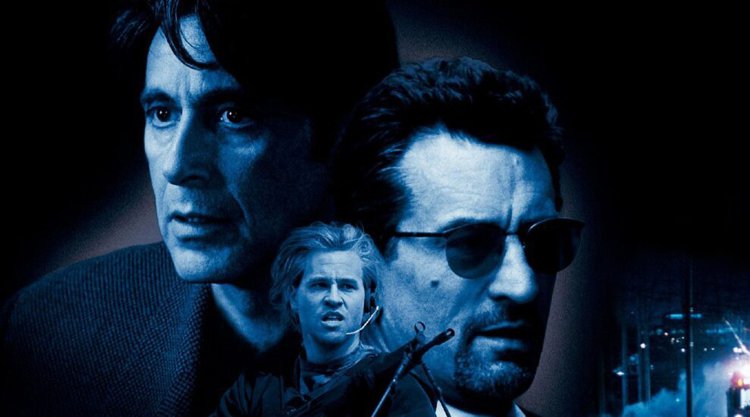
Sometimes films leave behind more than just a cultural imprint — they exert a tangible influence on the real world. The crime drama ‘Heat’ is exactly such a case. Michael Mann’s film has long been regarded as a benchmark of the genre, yet its story runs far deeper than the on-screen clash between a robber and a detective.
Released in 1996, the film quickly secured a special place in cinema history — largely thanks to a rare event: the first on-screen pairing of Robert De Niro and Al Pacino. Their legendary café scene is still considered one of the most intense and authentic moments in crime thriller history. However, beneath this artistic confrontation lies a real story that formed the basis of the script.
Where Did the Story Come From?

Michael Mann has always strived for maximum authenticity. The inspiration for Heat came from stories told by his friend, former police officer Chuck Adamson, who spent years tracking a professional bank robber named Neil McCauley. Their relationship went beyond the usual “cat-and-mouse” dynamic.
According to Adamson, they once ran into each other in a laundromat, talked, and even shared a drink (just like in the film) — with a silent understanding that sooner or later they would meet again “on the job,” and one of them would not walk away alive. This almost philosophical duel became the heart of the film.
But the most unexpected developments began after the premiere. The film proved so convincing that it inspired not only viewers, but also those on the other side of the law.
A French Follower of Hollywood
French criminal Rédoine Faïd, who published his memoirs and famously escaped from prison by helicopter, later openly admitted: “When we watched Heat in February 1996, it stunned us! The film moved everyone.” According to him, “It’s terrible to say, but we were hugely inspired by movies. When you’re a thief, watching gangster films is more useful and logical than watching Pretty Woman. It’s like an instruction manual.” In a world where experience and calculation mean everything, cinema became a source of ideas.
Faïd and his accomplices literally borrowed elements from the film while preparing their robberies. For instance, during an attack on an armored van in Villepinte, the criminals wore hockey masks — a direct reference to the film’s opening heist scene. Faïd meticulously studied the methods of McCauley’s crew, from organizing radio interception to executing a cold, precise getaway. Like the characters on screen, he preferred large-scale operations. His helicopter prison escape looked as if it had been scripted by Michael Mann himself.
Read more: ‘Run Rabbit Run’: The True Story That Inspired One of the Most Mysterious Films
This case raises a fascinating — and somewhat unsettling — question: where is the line between art and reality? Heat was conceived as an максимально honest and realistic film, and it is precisely this honesty that made it so influential.
At the same time, it’s important to understand that the film’s power lies not in romanticizing the criminal world, but in its depth. It is a story not so much about robberies as it is about people living by their own strict codes — about professionalism, loneliness, and the inevitable consequences of the paths they choose.
The real-life story of Rédoine Faïd, unlike that of the film’s protagonist, did not end in a tragic showdown on an airport runway. Yet the very fact that a work of fiction could so accurately reflect — and even influence — reality speaks to its uniqueness. Films like this inevitably make their way from the screen into the streets.
Read more: Is ‘Scarface’ Based on a True Story?