

The arrival of Francis Ford Coppola in American cinema was an event for which even Hollywood, with all its grandeur, was not entirely prepared. At a time when audiences were привыкли to confident heroes — sheriffs and gangsters — Coppola offered something different: his characters were vulnerable, contradictory, often lost and internally broken. This blend of delicate sentimentality and intellectual depth proved strikingly precise — the director didn’t just fit into the system; he became one of those who defined its voice.
His artistic thinking was largely shaped by his background. Coppola grew up in a family of Italian immigrants where music held a special place: his father, Carmine Coppola, was a flutist and composer who later wrote scores for several of his son’s films. It is no surprise that musicality permeates nearly all of Coppola’s work—from his early film You’re a Big Boy Now (1966) to the monumental Apocalypse Now (1979), where Ride of the Valkyries by Richard Wagner turns a helicopter attack into one of the most powerful scenes in cinema history.
Read more: From Platonic Love to Obsession: The Double Life of Alfred Hitchcock
Cinema entered Coppola’s life almost inevitably. As a child, after suffering from polio, he was confined to bed for a long time. This forced isolation nurtured an extraordinary imagination — he entertained himself with puppet theater and television, essentially creating his first worlds within four walls.
Later, while studying theater directing, Coppola experienced a creative shock after watching October by Sergei Eisenstein. The rhythm, power, and above all the virtuoso editing of the Soviet master transformed the young American’s perception of cinema. This “editing mindset” would later become Coppola’s hallmark — from the masterful parallel montage in the finale of The Godfather to the psychedelic chaos of Apocalypse Now.
By the early 1970s, Coppola had entered the pantheon of the world’s greatest directors. In just one decade, he created four pillars of world cinema: The Godfather, The Godfather Part II, The Conversation, and Apocalypse Now. For these works, he received numerous prestigious awards. The uniqueness of his success is underscored by a historical fact: at the Academy Awards in 1974, Coppola was essentially competing against himself — his intimate thriller The Conversation lost Best Picture to the epic second installment of the Corleone saga.
It was during this period that his “signature style” fully took shape: monumental narrative structures, deeply psychological characters, and that all-pervading драматичность critics would call “operatic.”
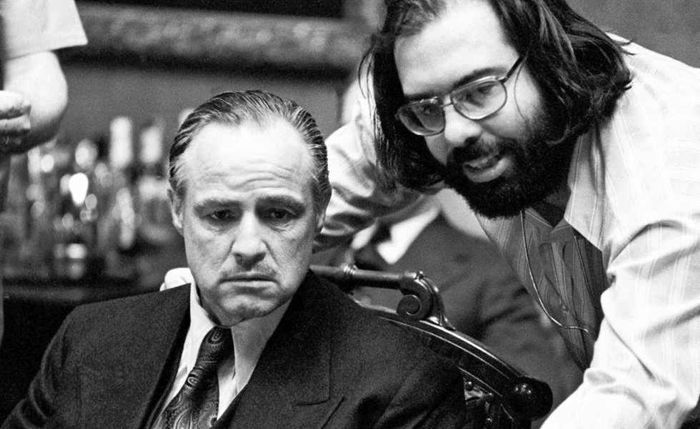
Marlon Brando and Francis Coppola on the set of ‘The Godfather’
However, the dizzying heights of The Godfather were followed by crushing setbacks. The production of Apocalypse Now turned into a personal nightmare for the director. Filming in the jungles of the Philippines dragged on for three years, the budget ballooned from $12 million to $30 million, and Coppola mortgaged all his property to complete the film. The world held its breath when critics initially responded coolly — but audiences decided otherwise, and the film became a cult classic.
Coppola consistently clashed with producers, believing risk to be an essential element of creativity. “If you don’t take risks, how are you going to create something beautiful that hasn’t been seen before?” became his manifesto. Unfortunately, risk did not always pay off financially. The musical One from the Heart (1982), which was expected to save his studio, was a disastrous flop, earning less than $1 million against a $25 million budget. The Hollywood legend was officially bankrupt.
Read more: How Did Marlon Brando Star in ‘The Godfather’ Without Knowing His Lines?
But Coppola would not be himself if he couldn’t rise again. He gave the world Rumble Fish (1983), revealing a new dimension of Mickey Rourke’s talent, and in 1990 triumphantly returned to the Sicilian mafia saga with The Godfather Part III. In 1992, he once again turned to Eisenstein’s legacy: while creating the visual style of Bram Stoker’s Dracula, he drew inspiration from Ivan the Terrible, transforming a vampire story into a lyrical cinematic tragedy.
Even at 85, the master has not stopped trying to surprise audiences. In 2024, he released Megalopolis, a dream project he had been developing for over 30 years and financed with his own money. Despite mixed reviews and even a tongue-in-cheek Golden Raspberry Awards win for Worst Director, Coppola remains unfazed. A man who created The Godfather cannot be shaken by an anti-award. He has long transcended ratings, leaving humanity a legacy that will be revisited for decades to come.
Read more: How did cinematographer Roman Vasyanov make it to Hollywood and then into directing?


