
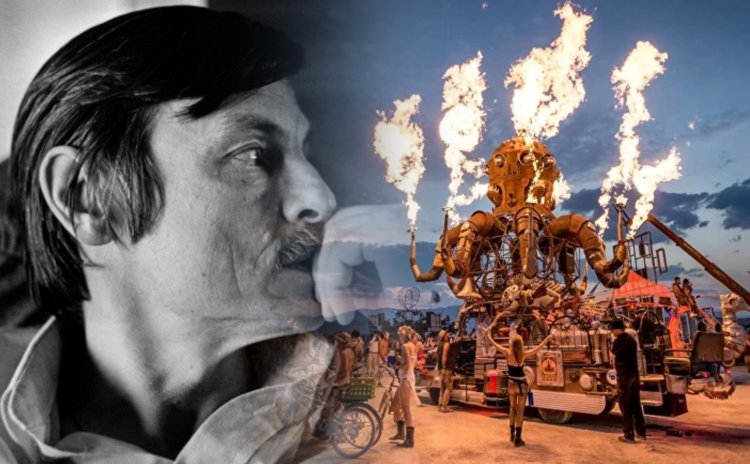
Today, Burning Man is considered one of the most unusual and fashionable festivals in the United States. Every year, tens of thousands of people travel to the Black Rock Desert in Nevada to spend a week in a world without money, advertising, or familiar social roles. A temporary city rises in the desert, giant art installations are built, people dance to electronic music, and at the end of the festival a massive human-shaped effigy is burned. Yet this American utopia has unexpected roots — and they lead straight to Soviet cinema.
The festival emerged in the mid-1980s and has since grown into a large-scale cultural phenomenon that combines a music and art gathering, a community of free exchange, and a social experiment. Nothing can be bought at Burning Man — with the exception of ice. Everything else participants give to each other voluntarily: food, drinks, help, ideas, emotions. Some repair bicycles, others stage performances, while some simply listen to and support strangers. The principle of gifting here is not just a beautiful metaphor but a real rule of life.
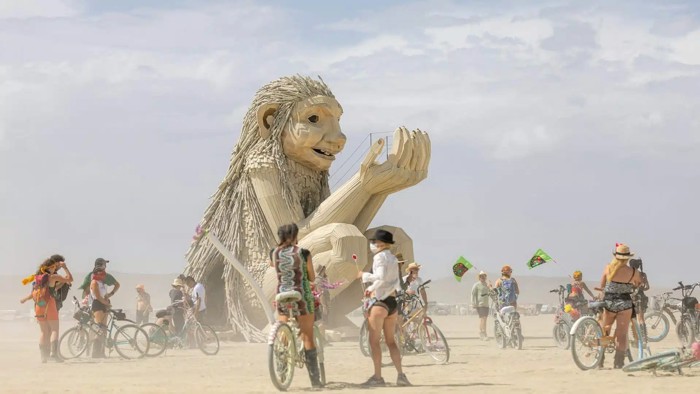
The city that appears in the middle of the desert exists for only eight days. It has streets, navigation services, and even an airport. Fantastical art cars move through it — vehicles transformed into moving sculptures, from mythical creatures to absurd architectural forms. Altogether it feels like a dream in which the boundaries between art and reality disappear.
Few people realize that the idea of Burning Man was shaped in part by the film Stalker by Andrei Tarkovsky. Released in 1979, the film deeply impressed the future founders of the festival — a group of friends led by artist Larry Harvey. At the center of the film lies the mysterious Zone, a place where the usual laws of the world no longer apply and where a person confronts their deepest desires.
In 1986, Harvey and his friends decided to recreate this feeling of stepping beyond everyday reality. Using whatever materials they had at hand, they assembled a small wooden figure of a man, carried it to a beach in San Francisco, and burned it in public. The act was simple, almost naive, but it already contained the core idea of the future festival — purification, liberation, and a shared collective experience.
Read more: Darker Than Marvel: The Spider-Man the U.S. Never Knew
Over time the ritual moved to the Black Rock Desert. The vast space, devoid of landmarks and familiar infrastructure, proved to be the perfect setting for a new “Zone.” Each year the number of participants grew, and what had begun as a spontaneous performance gradually evolved into an international festival with its own philosophy and a set of guiding principles.
In the early 1990s, Burning Man became particularly appealing to Americans tired of consumer culture and the rigid frameworks of the capitalist world. For them, the festival turned into a territory of freedom — a place where one could be anyone, experiment, make mistakes, and dream.
Thus, a Soviet philosophical film about the search for meaning unexpectedly became the starting point for one of the most radical cultural projects in the West. Inspired by Stalker, Burning Man became a personal Zone for thousands of people — a space where reality briefly retreats and it feels as though absolutely anything is possible.